

Introduction to CrowdStrike Alternatives
The endpoint security market is highly competitive, with numerous solutions vying for the top spot. Businesses today must navigate a complex landscape of threats, making it crucial to evaluate all available options thoroughly. Understanding the strengths and weaknesses of different solutions helps in making informed decisions that best protect your organization’s assets.
When considering endpoint security, CrowdStrike is often a name that comes up. However, it’s essential to explore alternatives and competitors to ensure you select the solution that fits your specific needs. This blog will provide an in-depth look at CrowdStrike, its top alternatives, and key competitors, giving you the insights needed to make the right choice for your business.
CrowdStrike Overview
CrowdStrike is a prominent player in the endpoint security market, widely recognized for its innovative approach to threat detection and response. Founded in 2011, CrowdStrike has rapidly grown to become a leader in cybersecurity, with its flagship product, CrowdStrike Falcon, at the forefront of its offerings. Falcon is a cloud-native platform that leverages artificial intelligence (AI) and machine learning (ML) to provide comprehensive protection against sophisticated cyber threats.
Key Features of CrowdStrike Falcon
- Endpoint Detection and Response (EDR): CrowdStrike Falcon offers continuous monitoring and detection of endpoint threats. It provides real-time visibility into activities across endpoints, enabling security teams to detect suspicious behavior and respond swiftly to incidents. The EDR capabilities allow for detailed forensic analysis, helping to understand the scope and impact of a breach.
- Threat Intelligence: One of CrowdStrike’s standout features is its integration with global threat intelligence. Falcon utilizes data from millions of sensors worldwide to stay ahead of emerging threats and adversary tactics. This threat intelligence is continuously updated, ensuring that security teams have the latest information to defend against new and evolving attacks.
- Cloud-Native Architecture: Unlike traditional endpoint security solutions that rely on on-premises infrastructure, CrowdStrike Falcon is entirely cloud-native. This architecture ensures scalability, rapid deployment, and minimal impact on system performance. The cloud-based approach also enables seamless updates and maintenance, reducing the burden on IT staff.
- Machine Learning and AI: CrowdStrike leverages advanced machine learning algorithms and AI to detect and mitigate threats in real-time. This reduces the reliance on traditional signature-based detection methods, which can be slow to respond to new threats. The AI-driven approach allows for the identification of patterns and anomalies that may indicate a security breach, providing proactive defense against attacks.
- Proactive Threat Hunting: CrowdStrike empowers security teams with tools for proactive threat hunting. This capability allows teams to actively search for and neutralize threats before they can cause significant damage. Threat hunting involves analyzing endpoint data to uncover hidden threats and understand the tactics, techniques, and procedures (TTPs) used by adversaries.
- Rapid Response and Remediation: CrowdStrike Falcon includes features for rapid response and remediation of incidents. Security teams can isolate compromised systems, remove malicious files, and restore systems to a secure state quickly. This minimizes the dwell time of attackers and reduces the overall impact of a breach.
Market Position and Reputation
CrowdStrike has established a strong market position through its innovative technology and effective cybersecurity solutions. The company has garnered numerous industry accolades and positive customer reviews for its ability to combat modern cyber threats. CrowdStrike’s success is also reflected in its financial performance, with significant revenue growth and market share gains.
Challenges and Considerations
While CrowdStrike Falcon offers robust endpoint security, it’s essential to consider potential challenges and limitations:
- Cost: CrowdStrike’s premium features come at a higher price point compared to some alternatives. Organizations must evaluate their budget and determine if the investment aligns with their security needs.
- Complexity: Implementing and managing CrowdStrike Falcon may require advanced technical expertise. Smaller organizations with limited IT resources may find it challenging to fully leverage the platform’s capabilities.
- Integration: While CrowdStrike integrates well with various security tools, organizations with existing security infrastructures must ensure seamless integration to avoid operational disruptions.
- Recent Global Outage: In recent months, CrowdStrike experienced a global outage caused by a software update. This outage impacted numerous customers, leading to temporary service disruptions and raising concerns about the reliability of updates and the company’s incident response capabilities. Organizations must weigh this risk and consider the potential impact of such outages on their operations.
CrowdStrike Falcon is a powerful endpoint security solution with advanced features and a fairly strong market reputation. However, it’s crucial to explore other solutions to ensure the best fit for your organization’s requirements. The next section will look at top CrowdStrike competitors and alternatives.
We’ll keep you up to date on the latest in Microsoft Cybersecurity.
Who are CrowdStrike competitors?
In endpoint security, there are several notable alternatives to CrowdStrike, each offering unique features and capabilities. The major competitors in this space include:
- Microsoft Defender for Endpoint: A comprehensive endpoint security solution that integrates seamlessly with other Microsoft products, providing advanced threat protection and EDR capabilities.
- Symantec Endpoint Protection (Broadcom): Offers a range of security features, including antivirus, anti-malware, and advanced threat protection, with a focus on large enterprises.
- McAfee Endpoint Security: Provides a unified platform for threat prevention, web control, and firewall protection, along with robust EDR capabilities.
- Sophos Intercept X: Known for its deep learning malware detection, anti-ransomware capabilities, and comprehensive EDR features.
- Sentinel One: Offers autonomous endpoint protection with AI-driven threat detection, response, and remediation capabilities, focusing on real-time threat intelligence.
- Carbon Black (VMware): Provides advanced threat detection and response, with a strong emphasis on behavior analysis and cloud-native architecture.
- Trend Micro Apex One: Combines threat detection, response, and investigation capabilities, with a focus on protecting against advanced threats and ransomware.
- Palo Alto Networks Cortex XDR: An extended detection and response solution that integrates network, endpoint, and cloud data to provide comprehensive threat detection and response.
Each of these solutions brings its own strengths and potential drawbacks, making it crucial for organizations to thoroughly evaluate them based on specific criteria. We’ll go into each in more detail at the end of the blog for you.
Alternatives to CrowdStrike Overview
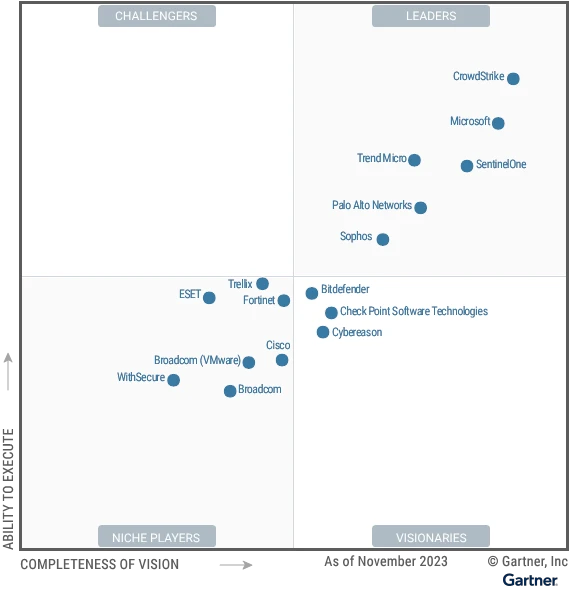
Comparison of Offerings, Market Share, and Gartner Position.
| Competitor | Gartner Position | Key Offerings | Market Share |
|---|---|---|---|
| Microsoft Defender for Endpoint | Leader |
|
Significant
Especially in Microsoft environments |
| Symantec Endpoint Protection (Broadcom) | Niche |
|
Strong presence in enterprise |
| McAfee Endpoint Security | N/A |
|
Strong presence in enterprise |
| Sophos Intercept X | Leader |
|
Popular in mid-sized enterprises and SMB |
| Sentinel One | Leader |
|
Gaining, especially in AI-driven security. |
| Carbon Black (VMware) | Niche |
|
Strong among organizations seeking advanced threat hunting |
| Trend Micro Apex One | Leader |
|
Widely used across various industries |
| Palo Alto Networks Cortex XDR | Leader |
|
Growing in large enterprises |
Wondering if Levacloud can solve your Microsoft Cybersecurity related challenge? Drop us a message!
- Microsoft Defender for Endpoint
Offerings: Microsoft Defender for Endpoint provides advanced threat protection, endpoint detection and response (EDR), automated investigation and response, and seamless integration with Microsoft 365 and Azure services. It leverages machine learning and AI to detect and mitigate threats in real-time.
Market Share: Microsoft Defender for Endpoint has a significant market share, particularly among organizations already using Microsoft’s suite of products. Its seamless integration within the Microsoft ecosystem makes it a popular choice for enterprises.
Customer Satisfaction: Customers appreciate the robust integration with other Microsoft products, the comprehensive threat detection capabilities, and the ease of management through a unified portal. However, some users find the initial configuration complex and resource-intensive.
Gartner Position: Microsoft Defender for Endpoint is consistently positioned as a Leader in the Gartner Magic Quadrant for Endpoint Protection Platforms (EPP), recognized for its completeness of vision and ability to execute.
- Symantec Endpoint Protection (Broadcom)
Offerings: Symantec Endpoint Protection offers multi-layered security, including antivirus, anti-malware, advanced threat protection, and EDR capabilities. It also features strong encryption and data loss prevention (DLP) capabilities.
Market Share: Symantec, now part of Broadcom, maintains a strong presence in the enterprise market due to its long-standing reputation and comprehensive security features.
Customer Satisfaction: Customers value the robust protection and comprehensive policy management. However, some users report that the solution can be resource-intensive and complex to manage.
Gartner Position: Symantec Endpoint Protection is typically placed as a Leader in the Gartner Magic Quadrant for Endpoint Protection Platforms, appreciated for its extensive feature set and strong enterprise focus.
- McAfee Endpoint Security
Offerings: McAfee Endpoint Security provides a unified platform combining threat prevention, web control, firewall protection, and EDR capabilities. It features Real Protect machine learning for advanced threat detection.
Market Share: McAfee has a solid market share, particularly in enterprises looking for integrated security solutions across multiple endpoints.
Customer Satisfaction: Users appreciate the unified management console and effective threat intelligence. However, some find the deployment and management complex, with the solution being resource-intensive.
Gartner Position: McAfee Endpoint Security is usually positioned as a Leader or Challenger in the Gartner Magic Quadrant for Endpoint Protection Platforms, recognized for its comprehensive approach and extensive capabilities.
- Sophos Intercept X
Offerings: Sophos Intercept X features deep learning technology, anti-ransomware capabilities, exploit prevention, EDR, and managed threat response (MTR) services. It focuses on providing comprehensive protection through multiple layers of security.
Market Share: Sophos Intercept X is popular among mid-sized enterprises and SMBs for its ease of use and advanced threat protection capabilities.
Customer Satisfaction: Customers appreciate the advanced threat protection, ease of deployment, and strong anti-ransomware features. Some users, however, report performance issues on lower-spec endpoints.
Gartner Position: Sophos Intercept X is often positioned as a Leader or Challenger in the Gartner Magic Quadrant for Endpoint Protection Platforms, noted for its innovative use of deep learning and strong anti-ransomware capabilities.
- Sentinel One
Offerings: Sentinel One provides AI-powered threat detection, autonomous response, and remediation capabilities. Its unique features include rollback capabilities to restore endpoints to a pre-infected state and cloud workload protection.
Market Share: Sentinel One has been rapidly gaining market share, especially among organizations seeking cutting-edge, AI-driven security solutions.
Customer Satisfaction: Users value the autonomous response, rollback capabilities, and comprehensive protection against a wide range of threats. Some users, however, mention the solution can be resource-intensive.
Gartner Position: Sentinel One is frequently positioned as a Leader in the Gartner Magic Quadrant for Endpoint Protection Platforms, recognized for its innovation and strong performance in threat detection and response.
- Carbon Black (VMware)
Offerings: Carbon Black provides behavioral EDR, threat hunting, incident response, and live response capabilities. It uses a behavior-based detection approach to identify and mitigate threats.
Market Share: Carbon Black, now part of VMware, has a strong presence in the market, particularly among organizations looking for advanced threat hunting and forensic capabilities.
Customer Satisfaction: Customers appreciate the behavior-based detection, detailed forensic data, and threat hunting capabilities. Some users, however, find it resource-intensive and complex to manage.
Gartner Position: Carbon Black is often positioned as a Leader or Challenger in the Gartner Magic Quadrant for Endpoint Protection Platforms, noted for its behavior-based detection and strong forensic capabilities.
- Trend Micro Apex One
Offerings: Trend Micro Apex One combines machine learning, behavioral analysis, EDR, and application control. It provides comprehensive protection with centralized management for endpoints.
Market Share: Trend Micro Apex One is widely used across various industries, known for its robust threat detection and comprehensive protection capabilities.
Customer Satisfaction: Users value the comprehensive protection, centralized management, and integrated threat intelligence. Some users report that the solution can be resource-intensive and complex to deploy.
Gartner Position: Trend Micro Apex One is frequently positioned as a Leader in the Gartner Magic Quadrant for Endpoint Protection Platforms, appreciated for its multi-layered protection and strong threat detection capabilities.
- Palo Alto Networks Cortex XDR
Offerings: Cortex XDR integrates endpoint, network, and cloud data to provide comprehensive threat detection and response capabilities. It uses behavioral analytics and automated response to mitigate threats.
Market Share: Cortex XDR has a growing market presence, particularly among large enterprises seeking integrated security across endpoints, networks, and cloud environments.
Customer Satisfaction: Customers value the holistic security approach, advanced analytics, and automated response capabilities. Some users find the deployment complex and resource-intensive.
Gartner Position: Palo Alto Networks Cortex XDR is positioned as a Visionary in the Gartner Magic Quadrant for Endpoint Protection Platforms, recognized for its innovative XDR approach and comprehensive threat detection capabilities.
Summary of Competitors
Each of these competitors offers unique strengths and capabilities, making them suitable for different organizational needs. Microsoft’s seamless integration with its ecosystem, Symantec’s enterprise-grade protection, McAfee’s unified platform, Sophos’s ease of use, Sentinel One’s autonomous response, Carbon Black’s behavior-based detection, Trend Micro’s comprehensive protection, and Palo Alto Networks’ holistic XDR approach provide diverse options for organizations seeking robust endpoint security solutions.
Choosing the Right Endpoint Security Solution
Selecting the right endpoint security solution for your organization requires careful consideration of various factors to ensure it meets your specific needs and integrates seamlessly with your existing infrastructure. Here are key factors to consider and recommendations based on different business needs and environments.
Factors to Consider When Selecting an Endpoint Security Solution
Security Requirements
- Threat Detection and Response: Evaluate the solution’s ability to detect and respond to a wide range of threats, including zero-day exploits, ransomware, and advanced persistent threats (APTs).
- Comprehensive Protection: Look for multi-layered security features such as antivirus, anti-malware, EDR, behavioral analytics, and application control.
- Proactive Threat Hunting: Consider solutions with advanced threat hunting capabilities to proactively search for indicators of compromise.
Integration Capabilities
- Existing Infrastructure: Assess how well the solution integrates with your current IT and security infrastructure, including other security tools, SIEM systems, and cloud services.
- Ecosystem Compatibility: Ensure compatibility with your organization’s primary ecosystem, such as Microsoft, VMware, or Palo Alto Networks, to leverage existing investments.
Ease of Management
- User Interface: Evaluate the ease of use of the management console and whether it provides comprehensive visibility and control over endpoint security.
- Centralized Management: Look for solutions that offer centralized management capabilities to simplify administration, especially for large deployments.
- Automated Response: Consider solutions with automated investigation and response features to reduce the workload on security teams.
Scalability
- Organizational Size: Ensure the solution can scale to meet the needs of your organization, whether you are a small business or a large enterprise.
- Cloud-Native Capabilities: Cloud-native solutions often offer better scalability and easier deployment compared to on-premises solutions.
Cost Considerations
- Licensing Models: Compare the pricing models of different solutions, including per-user, per-device, and bundled options, to determine the best value for your organization.
- Total Cost of Ownership: Consider not only the licensing costs but also the potential need for additional resources to manage and maintain the solution effectively.
Recommendations Based on Different Business Needs and Environments
1. Small to Mid-Sized Businesses (SMBs)
- Microsoft Defender for Endpoint: Its seamless integration with Microsoft 365 and Azure makes it an ideal choice for SMBs looking for robust protection without the complexity. The unified management and advanced threat detection capabilities provide comprehensive security tailored to smaller IT teams.
- Sophos Intercept X: Also a good choice for SMBs due to its ease of use and strong anti-ransomware features, but lacks the deep integration with Microsoft products that Defender for Endpoint offers.
2. Large Enterprises
- Microsoft Defender for Endpoint: For large enterprises, Defender for Endpoint offers advanced threat protection, EDR, and centralized management that scales effortlessly across thousands of endpoints. Its integration with Microsoft 365 and Azure AD ensures consistent security policies and simplified management.
- Symantec Endpoint Protection (Broadcom): Provides multi-layered security and is well-suited for large enterprises with complex security needs, though it does not offer the same level of integration with Microsoft’s ecosystem.
3. Organizations Seeking Advanced Threat Detection and Response
- Microsoft Defender for Endpoint: Leveraging AI and machine learning, Defender for Endpoint excels in detecting and responding to sophisticated threats. Its integration with Microsoft Threat Experts offers proactive hunting and incident response, making it a top choice for advanced security needs.
- CrowdStrike Falcon: Known for its AI-driven threat detection and proactive threat hunting, it is a strong contender but may not integrate as seamlessly into a Microsoft-centric environment as Defender for Endpoint.
4. Organizations with Diverse Environments
- Microsoft Defender for Endpoint: Offers robust cross-platform protection, supporting Windows, macOS, Linux, iOS, and Android devices. This makes it ideal for organizations with diverse environments, ensuring consistent security policies and simplified management through a single portal.
- Palo Alto Networks Cortex XDR: Provides holistic security by integrating endpoint, network, and cloud data, suitable for organizations with complex, multi-environment setups. However, it lacks the deep integration with Microsoft services found in Defender for Endpoint.
Recommendations
When choosing an endpoint security solution, aligning your choice with your organization’s existing infrastructure, security needs, and growth plans is crucial. Microsoft Defender for Endpoint stands out for its seamless integration with Microsoft’s suite of products, comprehensive threat protection, and ease of management. It is particularly advantageous for organizations heavily invested in the Microsoft ecosystem.
For smaller organizations, Defender for Endpoint offers robust protection without overwhelming complexity. Large enterprises benefit from its scalability and centralized management, while organizations with advanced security needs and diverse environments will appreciate its AI-driven threat detection and cross-platform support.
You have a pressing issue, but you’re not sure if Levacloud can help. We get it. Everyone has unique challenges they face in their IT environments. Schedule a free call today and talk us through it.
We’ll let you know how we can best support you.
CrowdStike Alternatives In Depth
In the following sections, we will delve into a detailed comparison of these leading alternatives, focusing on key aspects such as:
- Key Features: What essential functionalities each solution offers.
- Strengths: The main advantages and benefits of using each product.
- Weaknesses: Potential limitations and challenges associated with each solution.
- Integration Capabilities: How well each solution integrates with other tools and systems.
- User Experience: Feedback from users regarding ease of use, performance, and support.
- Cost Considerations: An overview of pricing models and value for money.
By examining these factors, we aim to provide a comprehensive understanding of each of the CrowdStrike competitors, helping you make an informed decision about the best endpoint security solution for your organization. Click on each to expand and read the in-depth information and comparisons.
Microsoft Defender For Endpoint
Microsoft Defender for Endpoint is a robust endpoint security solution that integrates seamlessly with other Microsoft products, providing comprehensive protection for organizations of all sizes. Here’s an in-depth look at its key features, strengths, weaknesses, integration capabilities, user experience, cost considerations, and a comparison to CrowdStrike, along with how Levacloud can help mitigate its weaknesses.
Key Features
- Advanced Threat Protection: Utilizes a combination of machine learning, behavioral analytics, and threat intelligence to detect and mitigate threats in real-time.
- Endpoint Detection and Response (EDR): Provides continuous monitoring and detailed forensic analysis of endpoint activities to quickly identify and respond to threats.
- Automated Investigation and Response (AIR): Automates the investigation process and remediation of threats, reducing the workload on security teams.
- Threat and Vulnerability Management: Identifies, assesses, and prioritizes vulnerabilities across endpoints to reduce the attack surface.
- Integration with Microsoft 365 and Azure: Offers seamless integration with other Microsoft services for unified security management.
Strengths
- Seamless Integration: Integrates natively with Microsoft 365 and Azure, providing a cohesive security ecosystem that enhances visibility and control across the organization.
- Comprehensive Protection: Combines multiple layers of protection, from threat detection to automated response, ensuring robust defense against sophisticated attacks.
- Scalability: Easily scales to accommodate the needs of both small businesses and large enterprises, leveraging Microsoft’s cloud infrastructure.
- Unified Management: Centralized security management through the Microsoft 365 Defender portal simplifies administration and monitoring.
Weaknesses and Levacloud’s Mitigation Strategies
- Complex Configuration: Initial setup and configuration can be complex, requiring skilled personnel to optimize settings and policies. Levacloud provides expert services to handle the initial setup and configuration of Microsoft Defender for Endpoint. Our team ensures that all settings and policies are optimized for your specific environment, reducing complexity and ensuring a smooth deployment.
- Microsoft-Centric: Best suited for organizations heavily invested in the Microsoft ecosystem; integration with non-Microsoft environments may not be as seamless. Levacloud offers comprehensive integration services to ensure that Microsoft Defender for Endpoint works seamlessly with your existing security infrastructure, including non-Microsoft environments. We tailor integration strategies to fit your unique needs, ensuring a cohesive security posture.
- Resource Intensive: Can be resource-intensive, particularly for smaller organizations with limited IT resources. Levacloud provides managed services to alleviate the resource burden on your IT team. We monitor, manage, and maintain your endpoint security, allowing your internal team to focus on core business activities while we ensure optimal performance and security.
Integration Capabilities
- Microsoft Ecosystem: Integrates effortlessly with other Microsoft products, including Azure Active Directory, Microsoft Intune, and Office 365.
- Third-Party Tools: Supports integration with various third-party security tools and SIEM systems, although it may require additional configuration.
- APIs: Provides APIs for custom integrations, allowing organizations to extend and tailor the platform to meet specific needs.
User Experience
- Ease of Use: Generally receives positive feedback for its user-friendly interface and comprehensive dashboards, which provide clear visibility into security posture.
- Performance: Users appreciate the platform’s performance and its minimal impact on endpoint performance.
- Support: Microsoft offers robust support through detailed documentation, community forums, and direct customer support, although some users report variability in response times.
Cost Considerations
- Pricing Models: Microsoft Defender for Endpoint offers flexible pricing models, including per-user and per-device options, making it accessible for organizations of varying sizes.
- Value for Money: While the solution may have a higher upfront cost compared to some alternatives, its comprehensive features and seamless integration with other Microsoft services provide significant value for organizations already using Microsoft products.
- Licensing: Often bundled with other Microsoft security offerings, which can provide cost savings and simplified billing for organizations utilizing multiple Microsoft solutions.
Comparison to CrowdStrike
- Threat Detection and Response: Both Microsoft Defender for Endpoint and CrowdStrike Falcon offer advanced threat detection and response capabilities. While CrowdStrike Falcon is renowned for its AI-driven threat detection and response, Microsoft Defender leverages its integration with the broader Microsoft ecosystem to provide comprehensive protection.
- Integration: Microsoft Defender excels in environments already using Microsoft products, offering seamless integration with tools like Azure Active Directory and Microsoft Intune. CrowdStrike, on the other hand, is known for its versatile integration capabilities with a wide range of third-party tools.
- User Experience: Both solutions are praised for their user-friendly interfaces and robust dashboards. However, users may find Microsoft Defender’s interface more intuitive if they are already familiar with Microsoft products.
- Scalability: Both solutions are highly scalable, but Microsoft Defender’s cloud-native architecture and integration with Azure provide an edge in terms of seamless scalability for large enterprises.
- Cost: Microsoft Defender for Endpoint may offer better value for organizations already invested in the Microsoft ecosystem due to bundled pricing and integration benefits. CrowdStrike, while potentially more expensive, provides standalone value with its cutting-edge threat detection technology.
Whilst both Microsoft Defender for Endpoint and CrowdStrike Falcon offer robust and comprehensive endpoint security solutions, the choice between the two may come down to specific organizational needs, existing infrastructure, and budget considerations. Microsoft Defender is particularly advantageous for organizations deeply integrated with Microsoft products, whereas CrowdStrike Falcon is favored for its advanced AI-driven threat detection and response capabilities. Levacloud can help mitigate the complexities and resource challenges associated with Microsoft Defender, ensuring a smooth and effective implementation.
Symantec Endpoint Protection (Broadcom)
Symantec Endpoint Protection, now a part of Broadcom, is a well-established endpoint security solution known for its comprehensive protection against a wide range of threats. Here’s an in-depth look at its key features, strengths, weaknesses, integration capabilities, user experience, cost considerations, and a comparison to CrowdStrike.
Key Features
- Multi-layered Protection: Combines signature-based and heuristic-based detection with advanced machine learning to identify and block malware.
- Antivirus and Anti-Malware: Provides robust protection against viruses, worms, Trojans, and other malicious software.
- Advanced Threat Protection (ATP): Includes features like network threat protection, intrusion prevention, and behavior-based detection to safeguard against sophisticated attacks.
- Endpoint Detection and Response (EDR): Offers advanced EDR capabilities to detect and respond to threats in real-time, providing detailed forensic analysis.
- Device and Application Control: Controls the use of external devices and applications to prevent data loss and unauthorized access.
Strengths
- Comprehensive Security: Offers a broad range of security features that protect against various types of cyber threats, providing a multi-layered defense strategy.
- Enterprise-Grade Protection: Well-suited for large enterprises with complex security requirements, offering scalable solutions and advanced threat protection.
- Strong Encryption: Includes strong encryption and data loss prevention (DLP) capabilities to protect sensitive data from unauthorized access and exfiltration.
- Reputation and Trust: Symantec has a long-standing reputation in the cybersecurity industry, backed by extensive threat intelligence and research.
Weaknesses
- Resource Intensive: Can be resource-intensive, potentially impacting system performance, especially on older or less powerful endpoints.
- Complex Deployment: Initial setup and deployment can be complex and time-consuming, requiring skilled IT personnel to configure and manage the solution effectively.
- Cost: May have a higher total cost of ownership compared to some other endpoint security solutions, which can be a consideration for smaller organizations.
Integration Capabilities
- Symantec Ecosystem: Integrates well with other Symantec security products, providing a cohesive security environment.
- Third-Party Tools: Supports integration with various third-party security tools and SIEM systems, though it may require additional configuration and management.
- APIs and Custom Integrations: Offers APIs for custom integrations, allowing organizations to extend the functionality of the platform to meet specific security needs.
User Experience
- Ease of Use: While powerful, the interface can be complex and may require training for effective use. Experienced users generally appreciate the depth of features available.
- Performance: Mixed feedback on performance, with some users noting that the solution can be resource-intensive and may slow down endpoint performance.
- Support: Broadcom provides comprehensive support, but some users have reported variability in the quality and responsiveness of customer support services.
Cost Considerations
- Pricing Models: Symantec Endpoint Protection offers various pricing models, typically based on the number of endpoints and the level of features required. Licensing can be complex, with different tiers for different capabilities.
- Value for Money: Provides significant value for large enterprises due to its comprehensive feature set and robust protection, though smaller organizations may find it cost-prohibitive.
- Total Cost of Ownership: Considerations include not just the licensing costs but also the potential need for additional resources to manage and maintain the solution effectively.
Comparison to CrowdStrike
- Threat Detection and Response: Both Symantec Endpoint Protection and CrowdStrike Falcon offer advanced threat detection and response capabilities. CrowdStrike is often praised for its AI-driven threat detection, while Symantec offers a more traditional multi-layered approach combined with advanced threat protection.
- Integration: Symantec integrates well within its own ecosystem and supports various third-party tools, similar to CrowdStrike’s flexible integration capabilities. However, CrowdStrike is often noted for its seamless integration with a wide range of third-party security tools.
- User Experience: CrowdStrike is generally recognized for its user-friendly interface and ease of use, whereas Symantec’s interface can be more complex and may require more training and experience to navigate effectively.
- Scalability: Both solutions are scalable to meet the needs of large enterprises, though Symantec’s resource-intensive nature may require more robust infrastructure compared to CrowdStrike’s cloud-native architecture.
- Cost: Symantec may have a higher total cost of ownership, particularly when considering the need for skilled personnel to manage and maintain the solution. CrowdStrike, while also premium-priced, is often considered more cost-effective in environments that value ease of use and rapid deployment.
In summary, Symantec Endpoint Protection offers a comprehensive and robust security solution with a strong focus on enterprise needs. Its multi-layered approach provides extensive protection, though it can be resource-intensive and complex to manage. In comparison, CrowdStrike Falcon offers advanced AI-driven threat detection and seamless integration, often making it a preferred choice for organizations seeking ease of use and efficient deployment.
McAfee Endpoint Security
McAfee Endpoint Security is a unified platform designed to provide comprehensive protection against a wide range of cyber threats. It combines multiple security technologies into a single solution, making it a popular choice for organizations looking to simplify their endpoint security management. Here’s an in-depth look at its key features, strengths, weaknesses, integration capabilities, user experience, cost considerations, and a comparison to CrowdStrike.
Key Features
- Threat Prevention: Uses signature-based and behavioral analysis to detect and prevent malware, ransomware, and other threats.
- Web Control: Monitors and controls web traffic to prevent access to malicious websites and reduce the risk of web-based threats.
- Firewall: Includes a built-in firewall to block unauthorized network traffic and protect against network-based attacks.
- Endpoint Detection and Response (EDR): Offers advanced EDR capabilities to detect and respond to threats in real-time, with detailed forensic analysis.
- Centralized Management: Provides a unified management console for configuring, managing, and monitoring endpoint security across the organization.
Strengths
- Unified Security Platform: Combines multiple security technologies into a single solution, simplifying management and reducing the complexity of deploying multiple point solutions.
- Comprehensive Protection: Offers a broad range of security features that protect against various types of threats, providing a multi-layered defense strategy.
- Advanced EDR Capabilities: Includes robust EDR features that provide detailed visibility into endpoint activities and enable quick response to threats.
- Scalability: Scalable to meet the needs of organizations of different sizes, from small businesses to large enterprises.
Weaknesses
- Complex Deployment: Initial setup and deployment can be complex and time-consuming, requiring skilled IT personnel to configure and manage the solution effectively.
- Resource Intensive: Can be resource-intensive, potentially impacting system performance, especially on older or less powerful endpoints.
- User Interface: Some users find the management console less intuitive compared to other solutions, requiring additional training and experience to use effectively.
Integration Capabilities
- McAfee Ecosystem: Integrates seamlessly with other McAfee security products, providing a cohesive security environment.
- Third-Party Tools: Supports integration with various third-party security tools and SIEM systems, although it may require additional configuration and management.
- APIs and Custom Integrations: Offers APIs for custom integrations, allowing organizations to extend the functionality of the platform to meet specific security needs.
User Experience
- Ease of Use: Mixed feedback on the ease of use, with some users finding the interface less intuitive and others appreciating the depth of features available.
- Performance: Performance can vary, with some users reporting that the solution can be resource-intensive and may slow down endpoint performance.
- Support: McAfee provides comprehensive support, but some users have reported variability in the quality and responsiveness of customer support services.
Cost Considerations
- Pricing Models: McAfee Endpoint Security offers various pricing models, typically based on the number of endpoints and the level of features required. Licensing can be complex, with different tiers for different capabilities.
- Value for Money: Provides significant value for organizations looking for a comprehensive and unified security solution, though smaller organizations may find it cost-prohibitive.
- Total Cost of Ownership: Considerations include not just the licensing costs but also the potential need for additional resources to manage and maintain the solution effectively.
Comparison to CrowdStrike
- Threat Detection and Response: Both McAfee Endpoint Security and CrowdStrike Falcon offer advanced threat detection and response capabilities. CrowdStrike is often praised for its AI-driven threat detection, while McAfee provides a comprehensive approach with integrated threat prevention, web control, and firewall features.
- Integration: McAfee integrates well within its own ecosystem and supports various third-party tools, similar to CrowdStrike’s flexible integration capabilities. However, CrowdStrike is often noted for its seamless integration with a wide range of third-party security tools.
- User Experience: CrowdStrike is generally recognized for its user-friendly interface and ease of use, whereas McAfee’s interface can be more complex and may require more training and experience to navigate effectively.
- Scalability: Both solutions are scalable to meet the needs of large enterprises, though McAfee’s resource-intensive nature may require more robust infrastructure compared to CrowdStrike’s cloud-native architecture.
- Cost: McAfee may have a higher total cost of ownership, particularly when considering the need for skilled personnel to manage and maintain the solution. CrowdStrike, while also premium-priced, is often considered more cost-effective in environments that value ease of use and rapid deployment.
In summary, McAfee Endpoint Security offers a comprehensive and unified security solution with a strong focus on integrating multiple security technologies into a single platform. Its multi-layered approach provides extensive protection, though it can be resource-intensive and complex to manage. In comparison, CrowdStrike Falcon offers advanced AI-driven threat detection and seamless integration, often making it a preferred choice for organizations seeking ease of use and efficient deployment.
Sophos Intercept X
Sophos Intercept X is a comprehensive endpoint security solution known for its advanced threat protection and ease of use. Combining multiple security technologies, including deep learning and anti-ransomware capabilities, it provides robust protection against a wide range of cyber threats. Here’s an in-depth look at its key features, strengths, weaknesses, integration capabilities, user experience, cost considerations, and a comparison to CrowdStrike.
Key Features
- Deep Learning Technology: Utilizes advanced machine learning models to detect and block malware, including zero-day threats, without relying on signatures.
- Anti-Ransomware: Protects against ransomware attacks by detecting and blocking malicious encryption processes and automatically restoring affected files.
- Exploit Prevention: Prevents the exploitation of vulnerabilities in applications, including zero-day exploits.
- Endpoint Detection and Response (EDR): Offers detailed visibility into endpoint activities and advanced threat hunting capabilities to identify and respond to threats in real-time.
- Managed Threat Response (MTR): Provides 24/7 threat hunting, detection, and response services from a team of cybersecurity experts.
Strengths
- Advanced Threat Protection: Combines deep learning, anti-ransomware, and exploit prevention technologies to provide comprehensive protection against a wide range of threats.
- Ease of Use: Known for its user-friendly interface and straightforward deployment process, making it accessible for organizations of all sizes.
- Effective Ransomware Defense: Strong anti-ransomware capabilities with automatic file recovery, reducing the impact of ransomware attacks.
- Integrated MTR Services: The option to add managed threat response services provides continuous monitoring and expert assistance in threat detection and response.
Weaknesses
- Resource Usage: Can be resource-intensive, potentially impacting system performance, especially during deep scans.
- Limited Third-Party Integration: While it integrates well within the Sophos ecosystem, integration with third-party tools can be limited compared to some competitors.
- Complex Features: Some advanced features, such as EDR and threat hunting, may require additional training and expertise to use effectively.
Integration Capabilities
- Sophos Ecosystem: Integrates seamlessly with other Sophos security products, providing a cohesive security environment.
- Third-Party Tools: Supports integration with various third-party security tools and SIEM systems, though it may require additional configuration and management.
- APIs and Custom Integrations: Offers APIs for custom integrations, allowing organizations to extend the functionality of the platform to meet specific security needs.
User Experience
- Ease of Use: Generally receives positive feedback for its intuitive interface and ease of deployment, making it accessible for users with varying levels of technical expertise.
- Performance: Performance can vary, with some users reporting that the solution can be resource-intensive and may slow down endpoint performance during scans.
- Support: Sophos provides comprehensive support through detailed documentation, community forums, and direct customer support, with generally positive feedback on responsiveness and assistance.
Cost Considerations
- Pricing Models: Sophos Intercept X offers flexible pricing models, typically based on the number of endpoints and the level of features required. Licensing can be straightforward, with options for additional managed services.
- Value for Money: Provides significant value for organizations looking for advanced threat protection and ease of use, though the cost can increase with the addition of managed services.
- Total Cost of Ownership: Considerations include not just the licensing costs but also the potential need for additional resources to manage and maintain the solution effectively.
Comparison to CrowdStrike
- Threat Detection and Response: Both Sophos Intercept X and CrowdStrike Falcon offer advanced threat detection and response capabilities. Sophos is noted for its deep learning and anti-ransomware technologies, while CrowdStrike is renowned for its AI-driven threat detection.
- Integration: Sophos integrates well within its own ecosystem but may have more limited third-party integration capabilities compared to CrowdStrike. CrowdStrike offers versatile integration with a wide range of third-party security tools.
- User Experience: Both solutions are praised for their user-friendly interfaces, though Sophos is often highlighted for its ease of deployment and use. CrowdStrike provides a comprehensive dashboard that many users find intuitive and powerful.
- Scalability: Both solutions are scalable to meet the needs of large enterprises, though Sophos’s resource-intensive nature may require more robust infrastructure compared to CrowdStrike’s cloud-native architecture.
- Cost: Sophos may offer competitive pricing, particularly for organizations looking for bundled managed services. CrowdStrike, while potentially more expensive, is often considered more cost-effective in environments that value ease of use and rapid deployment.
In summary, Sophos Intercept X offers a comprehensive and user-friendly security solution with advanced threat protection features, particularly strong in anti-ransomware and deep learning technologies. Its ease of deployment and integrated managed threat response services make it an attractive option for organizations seeking robust security with expert support. In comparison, CrowdStrike Falcon offers advanced AI-driven threat detection and versatile integration, making it a preferred choice for organizations seeking efficient deployment and seamless integration.
SentinelOne
SentinelOne is a leading endpoint security solution known for its autonomous protection capabilities, leveraging artificial intelligence and machine learning to detect, respond, and remediate threats in real-time. It is designed to provide comprehensive security for endpoints, cloud workloads, and containers. Here’s an in-depth look at its key features, strengths, weaknesses, integration capabilities, user experience, cost considerations, and a comparison to CrowdStrike.
Key Features
- AI-Powered Threat Detection: Uses artificial intelligence and machine learning to detect known and unknown threats, including fileless attacks and zero-day exploits.
- Autonomous Response and Remediation: Automatically isolates and remediates threats, reducing the need for manual intervention and minimizing the impact of attacks.
- Endpoint Detection and Response (EDR): Provides detailed visibility into endpoint activities, enabling advanced threat hunting and real-time response.
- Rollback Capabilities: Unique rollback feature that restores endpoints to a pre-infected state, effectively mitigating the impact of ransomware and other destructive attacks.
- Cloud Workload Protection: Extends security to cloud workloads and containers, offering unified protection across different environments.
Strengths
- Autonomous Protection: SentinelOne’s autonomous response capabilities significantly reduce the time and effort required for threat detection and remediation.
- Real-Time Threat Detection: Advanced AI and machine learning algorithms provide real-time threat detection and response, ensuring rapid mitigation of threats.
- Comprehensive Coverage: Protects against a wide range of threats, including fileless attacks, ransomware, and zero-day exploits.
- Rollback Feature: The rollback capability is a standout feature, allowing for quick restoration of systems affected by ransomware or other malware.
Weaknesses
- Resource Intensive: The platform can be resource-intensive, potentially impacting system performance, particularly during deep scans or intensive threat hunting activities.
- Complexity: Some users may find the advanced features and configuration options complex, requiring additional training and expertise to fully utilize.
- Cost: SentinelOne can be more expensive than other endpoint security solutions, which may be a consideration for smaller organizations with limited budgets.
Integration Capabilities
- Broad Integration: Integrates well with various third-party security tools and SIEM systems, providing flexibility in creating a comprehensive security ecosystem.
- API Support: Offers extensive API support for custom integrations, allowing organizations to extend the functionality of the platform to meet specific security needs.
- Cloud Integration: Provides seamless integration with cloud platforms, enhancing security for cloud workloads and containers.
User Experience
- Ease of Use: Generally receives positive feedback for its intuitive interface and ease of deployment, though some advanced features may require additional training.
- Performance: Users appreciate the platform’s performance, although some report that it can be resource-intensive during certain operations.
- Support: SentinelOne provides robust customer support, with users generally satisfied with the responsiveness and quality of assistance provided.
Cost Considerations
- Pricing Models: SentinelOne offers flexible pricing models, typically based on the number of endpoints and the level of features required. Licensing can be tailored to fit different organizational needs.
- Value for Money: While the solution may have a higher upfront cost, its comprehensive features and autonomous protection capabilities provide significant value for organizations looking for robust and efficient endpoint security.
- Total Cost of Ownership: Considerations include licensing costs, as well as the potential need for additional resources to manage and maintain the solution effectively.
Comparison to CrowdStrike
- Threat Detection and Response: Both SentinelOne and CrowdStrike Falcon offer advanced AI-driven threat detection and response capabilities. SentinelOne is noted for its autonomous response and rollback features, while CrowdStrike is renowned for its comprehensive threat intelligence and proactive threat hunting.
- Integration: Both solutions offer broad integration capabilities with various third-party tools. SentinelOne provides extensive API support, similar to CrowdStrike’s versatile integration options.
- User Experience: Both platforms are praised for their user-friendly interfaces and ease of deployment. SentinelOne’s autonomous capabilities and intuitive interface are particularly valued, though some users may find CrowdStrike’s interface more comprehensive and powerful for threat hunting.
- Scalability: Both solutions are highly scalable, suitable for large enterprises and diverse environments. SentinelOne’s cloud workload protection adds an extra layer of scalability for organizations leveraging cloud infrastructure.
- Cost: SentinelOne can be more expensive compared to CrowdStrike, particularly when considering its autonomous response capabilities and advanced features. CrowdStrike, while also premium-priced, may offer better cost-effectiveness for organizations seeking ease of use and rapid deployment.
In summary, SentinelOne offers a powerful and autonomous endpoint security solution with advanced AI-driven threat detection and response capabilities. Its unique rollback feature and comprehensive coverage make it an attractive option for organizations seeking robust and efficient protection. In comparison, CrowdStrike Falcon offers advanced threat intelligence and versatile integration, making it a preferred choice for organizations looking for seamless deployment and comprehensive threat hunting capabilities.
Carbon Black (VMware)
Carbon Black, acquired by VMware, is a leading endpoint security solution that provides advanced threat detection and response capabilities. Known for its behavior-based detection approach, Carbon Black aims to offer comprehensive protection against a wide range of cyber threats. Here’s an in-depth look at its key features, strengths, weaknesses, integration capabilities, user experience, cost considerations, and a comparison to CrowdStrike.
Key Features
- Behavioral EDR: Uses behavior-based detection to identify suspicious activities and potential threats in real-time, offering deep visibility into endpoint behaviors.
- Threat Hunting: Provides advanced threat hunting capabilities, allowing security teams to proactively search for indicators of compromise and uncover hidden threats.
- Incident Response: Facilitates rapid incident response with detailed forensic data, helping organizations understand the scope and impact of security incidents.
- Live Response: Allows security teams to perform remote investigations and remediation on compromised endpoints.
- Cloud-Native Platform: Leverages a cloud-native architecture to provide scalability, rapid deployment, and centralized management of endpoint security.
Strengths
- Behavioral Detection: The behavior-based approach helps detect sophisticated threats that may evade traditional signature-based detection methods.
- Detailed Forensics: Offers comprehensive forensic data and insights, aiding in thorough investigations and understanding of security incidents.
- Proactive Threat Hunting: Empowers security teams to actively hunt for threats and improve their overall security posture.
- Scalability: The cloud-native platform ensures scalability, making it suitable for organizations of various sizes and needs.
Weaknesses
- Resource Intensive: Can be resource-intensive, potentially impacting system performance, particularly during intensive threat hunting and forensic analysis.
- Complexity: Advanced features and capabilities may require significant training and expertise to fully utilize, potentially posing a challenge for smaller organizations.
- Cost: The solution can be expensive, especially when considering the comprehensive feature set and advanced capabilities offered.
Integration Capabilities
- VMware Ecosystem: Integrates seamlessly with VMware’s suite of security and IT management tools, providing a cohesive security environment.
- Third-Party Tools: Supports integration with various third-party security tools and SIEM systems, although it may require additional configuration and management.
- APIs and Custom Integrations: Offers APIs for custom integrations, allowing organizations to extend the functionality of the platform to meet specific security needs.
User Experience
- Ease of Use: Mixed feedback on the ease of use, with some users finding the interface less intuitive and others appreciating the depth of features available.
- Performance: Performance can vary, with some users reporting that the solution can be resource-intensive and may slow down endpoint performance during extensive operations.
- Support: VMware provides comprehensive support, but some users have reported variability in the quality and responsiveness of customer support services.
Cost Considerations
- Pricing Models: Carbon Black offers various pricing models, typically based on the number of endpoints and the level of features required. Licensing can be complex, with different tiers for different capabilities.
- Value for Money: Provides significant value for organizations looking for advanced threat detection and response capabilities, though smaller organizations may find it cost-prohibitive.
- Total Cost of Ownership: Considerations include not just the licensing costs but also the potential need for additional resources to manage and maintain the solution effectively.
Comparison to CrowdStrike
- Threat Detection and Response: Both Carbon Black and CrowdStrike Falcon offer advanced threat detection and response capabilities. Carbon Black is noted for its behavior-based detection and detailed forensic analysis, while CrowdStrike is renowned for its AI-driven threat detection and proactive threat hunting.
- Integration: Both solutions offer broad integration capabilities with various third-party tools. Carbon Black integrates well within the VMware ecosystem and supports extensive third-party integrations, similar to CrowdStrike’s versatile integration options.
- User Experience: Both platforms are praised for their comprehensive features, though CrowdStrike is often highlighted for its user-friendly interface and ease of use. Carbon Black’s interface may be more complex and require additional training to navigate effectively.
- Scalability: Both solutions are highly scalable, suitable for large enterprises and diverse environments. Carbon Black’s cloud-native architecture ensures scalability and centralized management, comparable to CrowdStrike’s cloud-native approach.
- Cost: Carbon Black can be more expensive compared to CrowdStrike, particularly when considering its comprehensive feature set and advanced capabilities. CrowdStrike, while also premium-priced, may offer better cost-effectiveness for organizations seeking ease of use and rapid deployment.
In summary, Carbon Black (VMware) offers a powerful endpoint security solution with advanced behavior-based detection and comprehensive forensic capabilities. Its proactive threat hunting and detailed forensic analysis make it an attractive option for organizations seeking robust security. In comparison, CrowdStrike Falcon offers advanced AI-driven threat detection and versatile integration, making it a preferred choice for organizations looking for seamless deployment and comprehensive threat hunting capabilities.
Trend Micro Apex One
Trend Micro Apex One is a comprehensive endpoint security solution that combines multiple layers of protection to defend against a wide range of cyber threats. Known for its robust threat detection and response capabilities, Apex One is designed to provide centralized security management for endpoints. Here’s an in-depth look at its key features, strengths, weaknesses, integration capabilities, user experience, cost considerations, and a comparison to CrowdStrike.
Key Features
- Machine Learning and AI: Uses advanced machine learning and AI algorithms to detect and block malware, including zero-day threats and fileless attacks.
- Behavioral Analysis: Monitors and analyzes behavior to identify and block suspicious activities, providing protection against advanced persistent threats (APTs).
- Endpoint Detection and Response (EDR): Offers comprehensive EDR capabilities, including threat hunting and detailed forensic analysis to quickly identify and respond to threats.
- Application Control: Controls the execution of applications on endpoints to prevent unauthorized software from running.
- Centralized Management: Provides a unified management console for configuring, managing, and monitoring endpoint security across the organization.
Strengths
- Comprehensive Protection: Combines multiple layers of security, including machine learning, behavioral analysis, and EDR, to provide robust protection against various threats.
- Integrated Threat Intelligence: Leverages Trend Micro’s extensive threat intelligence network to stay ahead of emerging threats and provide real-time updates.
- Application Control: Enhances security by preventing the execution of unauthorized or potentially harmful applications on endpoints.
- Ease of Management: The centralized management console simplifies the administration and monitoring of endpoint security, making it easier to manage large deployments.
Weaknesses
- Resource Usage: Can be resource-intensive, potentially impacting system performance, especially during deep scans and intensive threat analysis.
- Complex Deployment: Initial setup and deployment can be complex and time-consuming, requiring skilled IT personnel to configure and manage the solution effectively.
- User Interface: Some users find the management console less intuitive compared to other solutions, requiring additional training and experience to use effectively.
Integration Capabilities
- Trend Micro Ecosystem: Integrates seamlessly with other Trend Micro security products, providing a cohesive security environment.
- Third-Party Tools: Supports integration with various third-party security tools and SIEM systems, though it may require additional configuration and management.
- APIs and Custom Integrations: Offers APIs for custom integrations, allowing organizations to extend the functionality of the platform to meet specific security needs.
User Experience
- Ease of Use: Mixed feedback on the ease of use, with some users finding the interface less intuitive and others appreciating the depth of features available.
- Performance: Performance can vary, with some users reporting that the solution can be resource-intensive and may slow down endpoint performance during extensive operations.
- Support: Trend Micro provides comprehensive support through detailed documentation, community forums, and direct customer support, with generally positive feedback on responsiveness and assistance.
Cost Considerations
- Pricing Models: Trend Micro Apex One offers various pricing models, typically based on the number of endpoints and the level of features required. Licensing can be complex, with different tiers for different capabilities.
- Value for Money: Provides significant value for organizations looking for comprehensive threat detection and response capabilities, though smaller organizations may find it cost-prohibitive.
- Total Cost of Ownership: Considerations include not just the licensing costs but also the potential need for additional resources to manage and maintain the solution effectively.
Comparison to CrowdStrike
- Threat Detection and Response: Both Trend Micro Apex One and CrowdStrike Falcon offer advanced threat detection and response capabilities. Apex One is noted for its multi-layered approach combining machine learning, behavioral analysis, and EDR, while CrowdStrike is renowned for its AI-driven threat detection and proactive threat hunting.
- Integration: Both solutions offer broad integration capabilities with various third-party tools. Apex One integrates well within the Trend Micro ecosystem and supports extensive third-party integrations, similar to CrowdStrike’s versatile integration options.
- User Experience: Both platforms are praised for their comprehensive features, though CrowdStrike is often highlighted for its user-friendly interface and ease of use. Apex One’s interface may be more complex and require additional training to navigate effectively.
- Scalability: Both solutions are highly scalable, suitable for large enterprises and diverse environments. Apex One’s centralized management and integration capabilities ensure scalability, comparable to CrowdStrike’s cloud-native approach.
- Cost: Trend Micro Apex One can be more expensive compared to CrowdStrike, particularly when considering its comprehensive feature set and advanced capabilities. CrowdStrike, while also premium-priced, may offer better cost-effectiveness for organizations seeking ease of use and rapid deployment.
In summary, Trend Micro Apex One offers a powerful endpoint security solution with advanced threat detection and response capabilities, leveraging multiple layers of protection to defend against various threats. Its comprehensive protection and centralized management make it an attractive option for organizations seeking robust security. In comparison, CrowdStrike Falcon offers advanced AI-driven threat detection and versatile integration, making it a preferred choice for organizations looking for seamless deployment and comprehensive threat hunting capabilities.
Palo Alto Networks Cortex XDR
Palo Alto Networks Cortex XDR is an extended detection and response (XDR) solution that integrates endpoint, network, and cloud data to provide comprehensive threat detection and response capabilities. Known for its advanced analytics and unified security approach, Cortex XDR aims to offer robust protection across diverse environments. Here’s an in-depth look at its key features, strengths, weaknesses, integration capabilities, user experience, cost considerations, and a comparison to CrowdStrike.
Key Features
- Extended Detection and Response (XDR): Integrates data from endpoints, network, and cloud environments to provide a holistic view of threats and comprehensive detection and response capabilities.
- Behavioral Analytics: Utilizes behavioral analytics to detect and block sophisticated threats, including fileless attacks and advanced persistent threats (APTs).
- Automated Response: Automates the investigation and response process to reduce the time and effort required to mitigate threats.
- Threat Intelligence: Leverages Palo Alto Networks’ extensive threat intelligence to stay ahead of emerging threats and provide real-time updates.
- Forensic Analysis: Provides detailed forensic data and insights to help security teams understand the scope and impact of security incidents.
Strengths
- Holistic Security: Integrates data from multiple sources (endpoint, network, cloud) to provide a comprehensive view of the threat landscape and enhance detection capabilities.
- Advanced Analytics: Uses advanced behavioral analytics and machine learning to detect and respond to sophisticated threats in real-time.
- Automated Response: Reduces the workload on security teams by automating the investigation and response process, enabling faster mitigation of threats.
- Scalability: The cloud-native architecture ensures scalability, making it suitable for organizations of various sizes and needs.
Weaknesses
- Complex Deployment: Initial setup and deployment can be complex and time-consuming, requiring skilled IT personnel to configure and manage the solution effectively.
- Resource Usage: Can be resource-intensive, potentially impacting system performance, especially during deep scans and intensive threat analysis.
- Cost: The solution can be expensive, especially when considering the comprehensive feature set and advanced capabilities offered.
Integration Capabilities
- Palo Alto Networks Ecosystem: Integrates seamlessly with other Palo Alto Networks security products, providing a cohesive security environment.
- Third-Party Tools: Supports integration with various third-party security tools and SIEM systems, though it may require additional configuration and management.
- APIs and Custom Integrations: Offers APIs for custom integrations, allowing organizations to extend the functionality of the platform to meet specific security needs.
User Experience
- Ease of Use: Generally receives positive feedback for its comprehensive features, though some users may find the interface less intuitive compared to other solutions.
- Performance: Performance can vary, with some users reporting that the solution can be resource-intensive and may slow down endpoint performance during extensive operations.
- Support: Palo Alto Networks provides comprehensive support through detailed documentation, community forums, and direct customer support, with generally positive feedback on responsiveness and assistance.
Cost Considerations
- Pricing Models: Cortex XDR offers various pricing models, typically based on the number of endpoints and the level of features required. Licensing can be complex, with different tiers for different capabilities.
- Value for Money: Provides significant value for organizations looking for comprehensive threat detection and response capabilities, though smaller organizations may find it cost-prohibitive.
- Total Cost of Ownership: Considerations include not just the licensing costs but also the potential need for additional resources to manage and maintain the solution effectively.
Comparison to CrowdStrike
- Threat Detection and Response: Both Cortex XDR and CrowdStrike Falcon offer advanced threat detection and response capabilities. Cortex XDR is noted for its holistic security approach integrating endpoint, network, and cloud data, while CrowdStrike is renowned for its AI-driven threat detection and proactive threat hunting.
- Integration: Both solutions offer broad integration capabilities with various third-party tools. Cortex XDR integrates well within the Palo Alto Networks ecosystem and supports extensive third-party integrations, similar to CrowdStrike’s versatile integration options.
- User Experience: Both platforms are praised for their comprehensive features, though CrowdStrike is often highlighted for its user-friendly interface and ease of use. Cortex XDR’s interface may be more complex and require additional training to navigate effectively.
- Scalability: Both solutions are highly scalable, suitable for large enterprises and diverse environments. Cortex XDR’s cloud-native architecture ensures scalability and centralized management, comparable to CrowdStrike’s cloud-native approach.
- Cost: Cortex XDR can be more expensive compared to CrowdStrike, particularly when considering its comprehensive feature set and advanced capabilities. CrowdStrike, while also premium-priced, may offer better cost-effectiveness for organizations seeking ease of use and rapid deployment.
In summary, Palo Alto Networks Cortex XDR offers a powerful extended detection and response solution with advanced analytics and comprehensive threat detection capabilities. Its holistic security approach and automated response make it an attractive option for organizations seeking robust protection across diverse environments. In comparison, CrowdStrike Falcon offers advanced AI-driven threat detection and versatile integration, making it a preferred choice for organizations looking for seamless deployment and comprehensive threat hunting capabilities.
Conclusion on CrowdStrike Competitors
Selecting the right endpoint security solution is crucial for protecting your organization against sophisticated threats. This comprehensive analysis has highlighted the strengths, weaknesses, and unique offerings of major competitors to CrowdStrike, including Microsoft Defender for Endpoint, Symantec Endpoint Protection (Broadcom), McAfee Endpoint Security, Sophos Intercept X, SentinelOne, Carbon Black (VMware), Trend Micro Apex One, and Palo Alto Networks Cortex XDR.
Key Takeaways
- Advanced Threat Protection: Each solution provides robust protection against a wide range of threats, leveraging technologies such as AI, machine learning, behavioral analytics, and EDR.
- Integration Capabilities: Seamless integration with existing IT and security infrastructure is a critical factor, with solutions like Microsoft Defender for Endpoint excelling within the Microsoft ecosystem and Palo Alto Networks Cortex XDR offering comprehensive cross-environment protection.
- Ease of Use and Management: User-friendly interfaces, centralized management, and automated response features are essential for efficient security operations. Solutions like Sophos Intercept X and Trend Micro Apex One are particularly noted for their ease of use.
- Scalability: Cloud-native architectures and scalable solutions are necessary to meet the demands of growing organizations. SentinelOne and Carbon Black (VMware) offer strong scalability for diverse environments.
- Cost Considerations: Total cost of ownership, including licensing, deployment, and ongoing management costs, should be carefully evaluated to ensure value for money. Solutions like Microsoft Defender for Endpoint and Sophos Intercept X offer competitive pricing models that can be attractive for different organizational sizes and needs.
Final Thoughts
Choosing the right endpoint security solution involves balancing your organization’s specific security requirements with the capabilities of the solution. CrowdStrike Falcon remains a strong contender with its advanced AI-driven threat detection and proactive threat hunting. However, exploring CrowdStrike competitors and alternatives can reveal solutions that might better align with your existing infrastructure, budget, and unique security challenges.
For organizations deeply integrated with Microsoft products, Microsoft Defender for Endpoint offers seamless integration and comprehensive protection. SentinelOne and Palo Alto Networks Cortex XDR stand out for their innovative approaches to threat detection and response, suitable for organizations seeking cutting-edge security. Symantec Endpoint Protection and Trend Micro Apex One provide robust enterprise-grade protection, while Sophos Intercept X and McAfee Endpoint Security offer unified platforms with strong threat prevention capabilities.
Ultimately, the decision should be guided by a thorough assessment of your organization’s needs, existing infrastructure, and long-term security strategy. By making an informed choice, you can ensure robust protection against cyber threats and enhance your overall security posture.
If you’d like assistance in understanding if Microsoft Defender for Endpoint is right for your Organizational needs, give us a call at Levacloud. We’d be happy to help you understand if Microsoft would be right for you.


